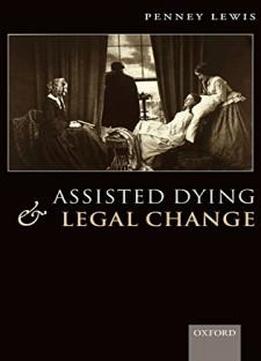
Assisted Dying And Legal Change
by Penney Lewis /
2007 / English / PDF
3.4 MB Download
The question of whether euthanasia and assisted suicide should be
legalized is often treated, by judges and commentators, as a
universal, ethical question, transcending national boundaries and
diverse legal systems. By thinking of the issue in this way, the
important context in which individual jurisdictions make decisions
about assisted dying and the significance of the legal methods
chosen to carry out those decisions is often lost.
The question of whether euthanasia and assisted suicide should be
legalized is often treated, by judges and commentators, as a
universal, ethical question, transcending national boundaries and
diverse legal systems. By thinking of the issue in this way, the
important context in which individual jurisdictions make decisions
about assisted dying and the significance of the legal methods
chosen to carry out those decisions is often lost.
This book examines the impact of the choice of diverse legal routes
towards legalization on the subsequent assisted dying regimes in
operation. This examination suggests that greater caution is needed
before relying on the experience of one jurisdiction when
discussing proposals for regulation of assisted dying in others.
The book seeks to demonstrate the need to explore the legal
environment in which assisted dying is performed or proposed in
order to evaluate the relevance of a particular legal experience to
other jurisdictions.
This book examines the impact of the choice of diverse legal routes
towards legalization on the subsequent assisted dying regimes in
operation. This examination suggests that greater caution is needed
before relying on the experience of one jurisdiction when
discussing proposals for regulation of assisted dying in others.
The book seeks to demonstrate the need to explore the legal
environment in which assisted dying is performed or proposed in
order to evaluate the relevance of a particular legal experience to
other jurisdictions.
The book explores the unsuccessful attempts to use constitutionally
entrenched human rights claims to challenge criminal prohibitions
on assisted suicide which reached the highest courts in the United
States, Canada and Europe. Their failure makes legalization through
a rights-based claim unlikely in any major common law or European
jurisdiction. Alternative routes towards legalization are then
discussed, including the defense of necessity, by which euthanasia
was effectively legalized in the Netherlands and an approach based
on compassion which has been proposed in France, as well as the
legislative approaches which have been taken in Oregon, Belgium and
the Northern Territory of Australia. All of these approaches are
compared in some detail, with particular attention paid to the
effectiveness and transferability of the ubiquitous slippery slope
arguments
The book explores the unsuccessful attempts to use constitutionally
entrenched human rights claims to challenge criminal prohibitions
on assisted suicide which reached the highest courts in the United
States, Canada and Europe. Their failure makes legalization through
a rights-based claim unlikely in any major common law or European
jurisdiction. Alternative routes towards legalization are then
discussed, including the defense of necessity, by which euthanasia
was effectively legalized in the Netherlands and an approach based
on compassion which has been proposed in France, as well as the
legislative approaches which have been taken in Oregon, Belgium and
the Northern Territory of Australia. All of these approaches are
compared in some detail, with particular attention paid to the
effectiveness and transferability of the ubiquitous slippery slope
arguments