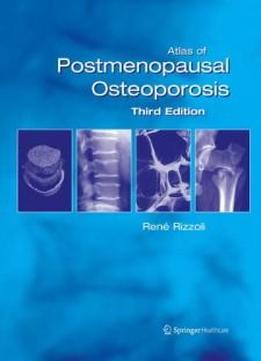
Atlas Of Postmenopausal Osteoporosis: Third Edition
by Rene Rizzoli /
2011 / English / PDF
5.7 MB Download
René Rizzoli Menopause is the time in a woman’s life when
reproductive capacity ends. Ovaries decrease their activity and the
production of sex hormones ceases. This period may be associated
with a large variety of symptoms affecting the cardiovascular and
urogenital systems, as well as skin, hair and bone. Bone capital is
accumulated by the end of the second decade and remains more or
less constant up to the time of menopause. Sex hormone deficiency
leads to accelerated bone turnover, a negative balance and
microarchitectural deterioration, which compromises bone strength,
thereby increasing bone fragility and, thus, fracture risk. By the
age of 80, it is estimated that 50% of trab- ular bone will have
been lost. Natural menopause occurs between the ages of 45 and 54
years all over the world. This age does not appear to have changed
significantly over the centuries. In contrast, since the middle of
the 19th century, life expectancy, particularly in women, has
increased considerably, with most women living to the age of 80
years or more in many regions of the world. This means that at the
age of 50 years, a woman will live for more than 30 years without
bone protection by sex hormones. This r- resents more than
one-third of a woman’s life. At the age of 50 years, the lifetime
risk to experience a fracture is about 50% (ie, one out of two
women will have a fracture during this period).
René Rizzoli Menopause is the time in a woman’s life when
reproductive capacity ends. Ovaries decrease their activity and the
production of sex hormones ceases. This period may be associated
with a large variety of symptoms affecting the cardiovascular and
urogenital systems, as well as skin, hair and bone. Bone capital is
accumulated by the end of the second decade and remains more or
less constant up to the time of menopause. Sex hormone deficiency
leads to accelerated bone turnover, a negative balance and
microarchitectural deterioration, which compromises bone strength,
thereby increasing bone fragility and, thus, fracture risk. By the
age of 80, it is estimated that 50% of trab- ular bone will have
been lost. Natural menopause occurs between the ages of 45 and 54
years all over the world. This age does not appear to have changed
significantly over the centuries. In contrast, since the middle of
the 19th century, life expectancy, particularly in women, has
increased considerably, with most women living to the age of 80
years or more in many regions of the world. This means that at the
age of 50 years, a woman will live for more than 30 years without
bone protection by sex hormones. This r- resents more than
one-third of a woman’s life. At the age of 50 years, the lifetime
risk to experience a fracture is about 50% (ie, one out of two
women will have a fracture during this period).