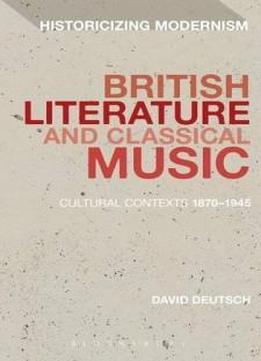
British Literature And Classical Music: Cultural Contexts 1870-1945 (historicizing Modernism)
by David Deutsch /
2015 / English / PDF
1.3 MB Download
British Literature and Classical Music
British Literature and Classical Music explores literary
representations of classical music in early 20th century British
writing. Covering authors ranging from T.S. Eliot and Virginia
Woolf to Aldous Huxley, H.G. Wells and D.H. Lawrence, the book
examines literature produced during a period of widely
proliferating philosophical, educational, and
performance-oriented musical activities in both public and
private settings. David Deutsch demonstrates how this
proliferation caused classical music to become an increasingly
vital element of British culture and a vehicle for exploring
contentious issues such as social mobility, sexual freedoms, and
international political rivalries.
explores literary
representations of classical music in early 20th century British
writing. Covering authors ranging from T.S. Eliot and Virginia
Woolf to Aldous Huxley, H.G. Wells and D.H. Lawrence, the book
examines literature produced during a period of widely
proliferating philosophical, educational, and
performance-oriented musical activities in both public and
private settings. David Deutsch demonstrates how this
proliferation caused classical music to become an increasingly
vital element of British culture and a vehicle for exploring
contentious issues such as social mobility, sexual freedoms, and
international political rivalries.
Through the use of archives of concert programs, cult novels, and
letters written during the First and Second World Wars, the book
examines how authors both celebrated and satirized the musicality
of the lower-middle and working classes, same-sex desiring
individuals, and cosmopolitan promoters of a shared European
culture to depict these groups as valuable members of and - less
frequently as threats to – British life.
Through the use of archives of concert programs, cult novels, and
letters written during the First and Second World Wars, the book
examines how authors both celebrated and satirized the musicality
of the lower-middle and working classes, same-sex desiring
individuals, and cosmopolitan promoters of a shared European
culture to depict these groups as valuable members of and - less
frequently as threats to – British life.