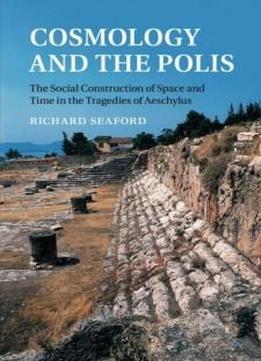
Cosmology And The Polis: The Social Construction Of Space And Time In The Tragedies Of Aeschylus
by Richard Seaford /
2015 / English / EPUB
1.2 MB Download
This book further develops Professor Seaford's innovative work on
the study of ritual and money in the developing Greek polis. It
employs the concept of the chronotope, which refers to the
phenomenon whereby the spatial and temporal frameworks explicit or
implicit in a text have the same structure and uncovers various
such chronotopes in the Homeric Hymn to Demeter and in particular
the tragedies of Aeschylus. Mikhail Bakhtin's pioneering use of the
chronotope was in literary analysis. This study by contrast derives
the variety of chronotopes manifest in Greek texts from the variety
of socially integrative practices in the developing polis - notably
reciprocity, collective ritual, and monetised exchange. In
particular, the tragedies of Aeschylus embodies the reassuring
absorption of the new and threatening monetised chronotope into the
traditional chronotope that arises from collective ritual with its
aetiological myth.
This book further develops Professor Seaford's innovative work on
the study of ritual and money in the developing Greek polis. It
employs the concept of the chronotope, which refers to the
phenomenon whereby the spatial and temporal frameworks explicit or
implicit in a text have the same structure and uncovers various
such chronotopes in the Homeric Hymn to Demeter and in particular
the tragedies of Aeschylus. Mikhail Bakhtin's pioneering use of the
chronotope was in literary analysis. This study by contrast derives
the variety of chronotopes manifest in Greek texts from the variety
of socially integrative practices in the developing polis - notably
reciprocity, collective ritual, and monetised exchange. In
particular, the tragedies of Aeschylus embodies the reassuring
absorption of the new and threatening monetised chronotope into the
traditional chronotope that arises from collective ritual with its
aetiological myth.