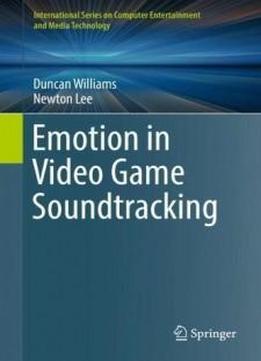
Emotion In Video Game Soundtracking (international Series On Computer Entertainment And Media Technology)
by Newton Lee /
2018 / English / PDF
5.8 MB Download
This book presents an overview of the emerging field of emotion
in videogame soundtracking. The emotional impact of music has
been well-documented, particularly when used to enhance the
impact of a multimodal experience, such as combining images with
audio as found in the videogames industry. Soundtracking
videogames presents a unique challenge compared to traditional
composition (for example film music) in that the narrative of
gameplay is non-linear – Player dependent actions can change the
narrative and thus the emotional characteristics required in the
soundtrack. Historical approaches to emotion measurement,
and the musical feature mapping and music selection that might be
used in video game soundtracking are outlined, before
a series of cutting edge examples are given. These examples
include algorithmic composition techniques, automated emotion
matching from biosensors, motion capture techniques,
emotionally-targeted speech synthesis and signal processing, and
automated repurposing of existing music (for example from a
players own library). The book concludes with some possibilities
for the future.
This book presents an overview of the emerging field of emotion
in videogame soundtracking. The emotional impact of music has
been well-documented, particularly when used to enhance the
impact of a multimodal experience, such as combining images with
audio as found in the videogames industry. Soundtracking
videogames presents a unique challenge compared to traditional
composition (for example film music) in that the narrative of
gameplay is non-linear – Player dependent actions can change the
narrative and thus the emotional characteristics required in the
soundtrack. Historical approaches to emotion measurement,
and the musical feature mapping and music selection that might be
used in video game soundtracking are outlined, before
a series of cutting edge examples are given. These examples
include algorithmic composition techniques, automated emotion
matching from biosensors, motion capture techniques,
emotionally-targeted speech synthesis and signal processing, and
automated repurposing of existing music (for example from a
players own library). The book concludes with some possibilities
for the future.