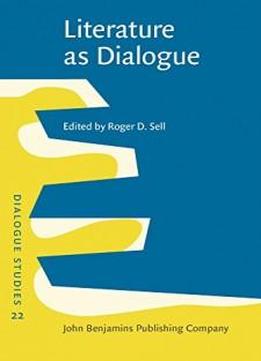
Literature As Dialogue: Invitations Offered And Negotiated (dialogue Studies)
by Roger D. Sell /
2014 / English / PDF
1.4 MB Download
How is it that some texts achieve the status of literature? Partly,
at least, because the relationship they allow between their writers
and the people who respond to them is fundamentally egalitarian.
This is the insight explored by members of the Åbo literary
communication network, who in this new book develop fresh
approaches to literary works of widely varied provenance. The
authors examined have written in Ancient Greek, Táng Dynasty
Chinese, Middle, Modern and Contemporary English, German, Romanian,
Polish, Russian and Hebrew. But each and every one of them is shown
as having offered their human fellows something which, despite some
striking appearances to the contrary, amounts to a welcoming
invitation. This their audiences have then been able to negotiate
in a spirit of dialogical interchange.
How is it that some texts achieve the status of literature? Partly,
at least, because the relationship they allow between their writers
and the people who respond to them is fundamentally egalitarian.
This is the insight explored by members of the Åbo literary
communication network, who in this new book develop fresh
approaches to literary works of widely varied provenance. The
authors examined have written in Ancient Greek, Táng Dynasty
Chinese, Middle, Modern and Contemporary English, German, Romanian,
Polish, Russian and Hebrew. But each and every one of them is shown
as having offered their human fellows something which, despite some
striking appearances to the contrary, amounts to a welcoming
invitation. This their audiences have then been able to negotiate
in a spirit of dialogical interchange.
Part I of the book poses the question: How, in offering their
invitation, have writers respected their audiences’ human autonomy?
This is the province of what Åbo scholars call "communicational
criticism". Part II asks how an audience negotiating a literary
invitation can be encouraged to respect the human autonomy of the
writer who has offered it. In Åbo parlance, such encouragement is
the task of "mediating criticism". These two modes of criticism
naturally complement each other, and in their shared concern for
communicational ethics ultimately seek to further a post-postmodern
world that would be global without being hegemonic.
Part I of the book poses the question: How, in offering their
invitation, have writers respected their audiences’ human autonomy?
This is the province of what Åbo scholars call "communicational
criticism". Part II asks how an audience negotiating a literary
invitation can be encouraged to respect the human autonomy of the
writer who has offered it. In Åbo parlance, such encouragement is
the task of "mediating criticism". These two modes of criticism
naturally complement each other, and in their shared concern for
communicational ethics ultimately seek to further a post-postmodern
world that would be global without being hegemonic.