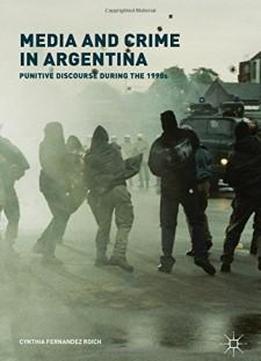
Media And Crime In Argentina: Punitive Discourse During The 1990s
by Cynthia Fernandez Roich /
2017 / English / PDF
6.3 MB Download
This book analyses the punitive crime discourse in the Argentinean
press during the 1990s. Fernandez Roich focusses on several
features of media discourse during this time, such as: the notion
that petty criminals ‘deserve to die' in reference to police
brutality and killings, the phenomenon of ‘vindicators’ or how
common citizens turned into ‘evil’ modern heroes in the press, and
the parallelism between the military discourse under the military
regime and the punitive discourse under democracy. In addition, the
book also investigates the alleged natural propensity towards
breaking the law ingrained within Argentinean culture, the
so-called 'viveza criolla' and the well-ingrained idea that to get
ahead you have to participate in corrupt practices.
This book analyses the punitive crime discourse in the Argentinean
press during the 1990s. Fernandez Roich focusses on several
features of media discourse during this time, such as: the notion
that petty criminals ‘deserve to die' in reference to police
brutality and killings, the phenomenon of ‘vindicators’ or how
common citizens turned into ‘evil’ modern heroes in the press, and
the parallelism between the military discourse under the military
regime and the punitive discourse under democracy. In addition, the
book also investigates the alleged natural propensity towards
breaking the law ingrained within Argentinean culture, the
so-called 'viveza criolla' and the well-ingrained idea that to get
ahead you have to participate in corrupt practices.
Despite the significant scholarly interest in the United States
and Europe in the last Argentinean dictatorship (1976-1983),
little attention has been paid to the role of Argentinean
newspapers in supporting the military coup d’état. The analysis
of this media discourse is critical to understanding the
support enjoyed by the armed forces in power: the vast majority
of the population was not informed about the disappearances or
the concentration camps until well into the 1980s. This project
provides an in-depth qualitative content analysis of front
pages, chronicles, editorials and photographs of Argentinean
newspapers before and after the military intervention that will
aid scholars of criminal justice and Latin American political
regimes understand the impact of the support given to the
military government.
Despite the significant scholarly interest in the United States
and Europe in the last Argentinean dictatorship (1976-1983),
little attention has been paid to the role of Argentinean
newspapers in supporting the military coup d’état. The analysis
of this media discourse is critical to understanding the
support enjoyed by the armed forces in power: the vast majority
of the population was not informed about the disappearances or
the concentration camps until well into the 1980s. This project
provides an in-depth qualitative content analysis of front
pages, chronicles, editorials and photographs of Argentinean
newspapers before and after the military intervention that will
aid scholars of criminal justice and Latin American political
regimes understand the impact of the support given to the
military government.