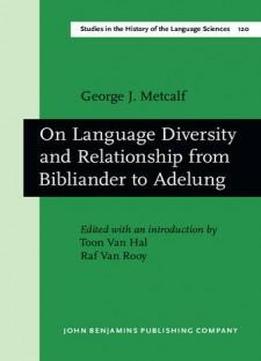
On Language Diversity And Relationship From Bibliander To Adelung (studies In The History Of The Language Sciences)
by George J. Metcalf /
2013 / English / PDF
1.5 MB Download
From the Renaissance onwards, European scholars began to collect
and study the various languages of the Old and the New Worlds. The
recognition of language diversity encouraged them to explain how
differences between languages emerged, why languages kept changing,
and in what language families they could be classified. The present
volume brings together the papers of the late George J. Metcalf
(1908–1994) that discuss the search for possible genetic language
relationships, and the study of language developments and origins,
in Early Modern Europe. Two general chapters, surveying the period
between the 16th and 18th century, are followed by detailed case
studies of the contributions of Swiss, Dutch, and German scholars
such as Theodor Bibliander (1504–1564), Konrad Gesner (1516–1565),
Philippus Cluverius (1580–1623), Hugo Grotius (1583–1645), and
Justus Georg Schottelius (1612–1676). This collection of important
studies, a number of which have become very hard to find, has been
framed by a detailed Editors’ Introduction, a biographical sketch
of the author, a master list of references, and indexes of
biographical names and of subjects, terms, and languages.
From the Renaissance onwards, European scholars began to collect
and study the various languages of the Old and the New Worlds. The
recognition of language diversity encouraged them to explain how
differences between languages emerged, why languages kept changing,
and in what language families they could be classified. The present
volume brings together the papers of the late George J. Metcalf
(1908–1994) that discuss the search for possible genetic language
relationships, and the study of language developments and origins,
in Early Modern Europe. Two general chapters, surveying the period
between the 16th and 18th century, are followed by detailed case
studies of the contributions of Swiss, Dutch, and German scholars
such as Theodor Bibliander (1504–1564), Konrad Gesner (1516–1565),
Philippus Cluverius (1580–1623), Hugo Grotius (1583–1645), and
Justus Georg Schottelius (1612–1676). This collection of important
studies, a number of which have become very hard to find, has been
framed by a detailed Editors’ Introduction, a biographical sketch
of the author, a master list of references, and indexes of
biographical names and of subjects, terms, and languages.