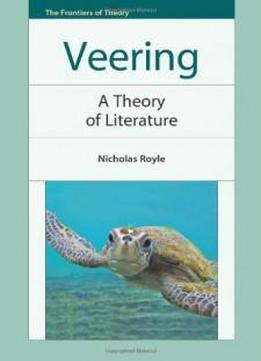
Veering: A Theory Of Literature (the Frontiers Of Theory)
by Nicholas Royle /
2011 / English / PDF
1.6 MB Download
Reflections on the figure of veering form the basis for a new
theory of literature. Exploring images of swerving, loss of
control, digressing and deviating,
Reflections on the figure of veering form the basis for a new
theory of literature. Exploring images of swerving, loss of
control, digressing and deviating,Veering
Veering provides new
critical perspectives on all major literary genres: the novel,
poetry, drama, the short story and the essay, as well as 'creative
writing'. Royle works with insights from Lewis Carroll, Freud,
Adorno, Raymond Williams, Edward Said, Deleuze, Cixous and Derrida.
With wit and irony he investigates 'veering' in the writings of
Jonson, Milton, Dryden, Wordsworth, Coleridge, Melville, Hardy,
Proust, Lawrence, Bowen, J.H. Prynne and many others. Contrary to a
widespread sense that literature has become increasingly irrelevant
to our culture and everyday life, Royle brilliantly traces a
strange but compelling 'literary turn'.
provides new
critical perspectives on all major literary genres: the novel,
poetry, drama, the short story and the essay, as well as 'creative
writing'. Royle works with insights from Lewis Carroll, Freud,
Adorno, Raymond Williams, Edward Said, Deleuze, Cixous and Derrida.
With wit and irony he investigates 'veering' in the writings of
Jonson, Milton, Dryden, Wordsworth, Coleridge, Melville, Hardy,
Proust, Lawrence, Bowen, J.H. Prynne and many others. Contrary to a
widespread sense that literature has become increasingly irrelevant
to our culture and everyday life, Royle brilliantly traces a
strange but compelling 'literary turn'.