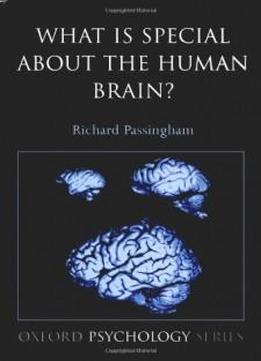
What Is Special About The Human Brain? (oxford Psychology Series)
by Richard Passingham /
2008 / English / PDF
2 MB Download
It is plausible that evolution could have created the human
skeleton, but it is hard to believe that it created the human mind.
Yet, in six or seven million years evolution came up with Homo
sapiens, a creature unlike anything the world had ever known. The
mental gap between man and ape is immense, and yet evolution
bridged that gap in so short a space of time. Since the brain is
the organ of the mind, it is natural to assume that during the
evolution of our hominid ancestors there were changes in the brain
that can account for this gap. This book is a search for those
changes.
It is plausible that evolution could have created the human
skeleton, but it is hard to believe that it created the human mind.
Yet, in six or seven million years evolution came up with Homo
sapiens, a creature unlike anything the world had ever known. The
mental gap between man and ape is immense, and yet evolution
bridged that gap in so short a space of time. Since the brain is
the organ of the mind, it is natural to assume that during the
evolution of our hominid ancestors there were changes in the brain
that can account for this gap. This book is a search for those
changes.
It is not enough to understand the universe, the world, or the
animal kingdom: we need to understand ourselves. Humans are unlike
any other animal in dominating the earth and adapting to any
environment. This book searches for specializations in the human
brain that make this possible. As well as considering the
anatomical differences, it examines the contribution of different
areas of the brain - reviewing studies in which functional brain
imaging has been used to study the brain mechanisms that are
involved in perception, manual skill, language, planning,
reasoning, and social cognition. It considers a range of skills
unique to us - for example our ability to learn a language and pass
on cultural traditions in this way, and become aware of our own
throughts through inner speech
It is not enough to understand the universe, the world, or the
animal kingdom: we need to understand ourselves. Humans are unlike
any other animal in dominating the earth and adapting to any
environment. This book searches for specializations in the human
brain that make this possible. As well as considering the
anatomical differences, it examines the contribution of different
areas of the brain - reviewing studies in which functional brain
imaging has been used to study the brain mechanisms that are
involved in perception, manual skill, language, planning,
reasoning, and social cognition. It considers a range of skills
unique to us - for example our ability to learn a language and pass
on cultural traditions in this way, and become aware of our own
throughts through inner speech
Written in a lively style by a distinguished scientist who has made
his own major contribution to our understanding of the mind, the
book is a far-reaching and exciting quest to understand those
things that make humans unique.
Written in a lively style by a distinguished scientist who has made
his own major contribution to our understanding of the mind, the
book is a far-reaching and exciting quest to understand those
things that make humans unique.






![German Grammar In Context (Languages In Context) (English And German Edition) [English, German]](/media/uploads/2020/5/german-grammar-in-context-languages-in-context-english-and-german-edition-english-german.jpg.147x205_q85.jpg)