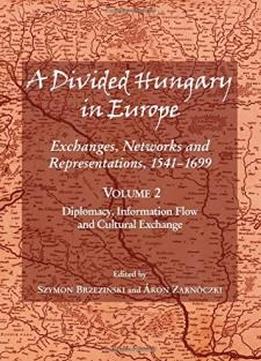
A Divided Hungary In Europe: Diplomacy, Information Flow And Cultural Exchange
by Gabor Almasi /
2014 / English / PDF
2.7 MB Download
Despite fragmentation, heterogeneity and the continuous pressure of
the Ottoman Empire, early modern "divided Hungary" witnessed a
surprising cultural flourishing in the sixteenth century, and
maintained this common cultural identity in the seventeenth
century. This could hardly have been possible without intense
exchange with the rest of Europe. This three-volume series about
early modern Hungary divided by Ottoman presence approaches themes
of exchange of information and knowledge from two perspectives:
namely, exchange through traditional channels provided by
religious/educational institutions and the system of European study
tours (Volume 1: Study Tours and Intellectual-Religious
Relationships), and the less-regular channels and improvised
networks of political diplomacy (Volume 2: Diplomacy, Information
Flow and Cultural Exchange). A by-product of this exchange of
information was the changing image of early modern Hungary and
Transylvania, which is presented in the third, and in some aspects
concluding, volume of essays (Volume 3: The Making and Uses of the
Image of Hungary and Transylvania). Unlike earlier approaches to
the same questions, these volumes draw an alternative map of early
modern Hungary. On this map, the centre-periphery conceptions of
European early modern culture are replaced by new narratives
written from the perspective of historical actors, and the
dominance of Western-Hungarian relationships is kept in balance due
to the significance of Hungary's direct neighbours, most
importantly the Ottoman Empire.
Despite fragmentation, heterogeneity and the continuous pressure of
the Ottoman Empire, early modern "divided Hungary" witnessed a
surprising cultural flourishing in the sixteenth century, and
maintained this common cultural identity in the seventeenth
century. This could hardly have been possible without intense
exchange with the rest of Europe. This three-volume series about
early modern Hungary divided by Ottoman presence approaches themes
of exchange of information and knowledge from two perspectives:
namely, exchange through traditional channels provided by
religious/educational institutions and the system of European study
tours (Volume 1: Study Tours and Intellectual-Religious
Relationships), and the less-regular channels and improvised
networks of political diplomacy (Volume 2: Diplomacy, Information
Flow and Cultural Exchange). A by-product of this exchange of
information was the changing image of early modern Hungary and
Transylvania, which is presented in the third, and in some aspects
concluding, volume of essays (Volume 3: The Making and Uses of the
Image of Hungary and Transylvania). Unlike earlier approaches to
the same questions, these volumes draw an alternative map of early
modern Hungary. On this map, the centre-periphery conceptions of
European early modern culture are replaced by new narratives
written from the perspective of historical actors, and the
dominance of Western-Hungarian relationships is kept in balance due
to the significance of Hungary's direct neighbours, most
importantly the Ottoman Empire.