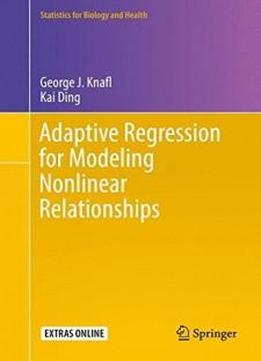
Adaptive Regression For Modeling Nonlinear Relationships (statistics For Biology And Health)
by George J. Knafl /
2016 / English / PDF
6.2 MB Download
This book presents methods for investigating whether
relationships are linear or nonlinear and for adaptively fitting
appropriate models when they are nonlinear. Data analysts will
learn how to incorporate nonlinearity in one or more predictor
variables into regression models for different types of outcome
variables. Such nonlinear dependence is often not considered in
applied research, yet nonlinear relationships are common and so
need to be addressed. A standard linear analysis can produce
misleading conclusions, while a nonlinear analysis can provide
novel insights into data, not otherwise possible.
This book presents methods for investigating whether
relationships are linear or nonlinear and for adaptively fitting
appropriate models when they are nonlinear. Data analysts will
learn how to incorporate nonlinearity in one or more predictor
variables into regression models for different types of outcome
variables. Such nonlinear dependence is often not considered in
applied research, yet nonlinear relationships are common and so
need to be addressed. A standard linear analysis can produce
misleading conclusions, while a nonlinear analysis can provide
novel insights into data, not otherwise possible.
A variety of examples of the benefits of modeling nonlinear
relationships are presented throughout the book. Methods are
covered using what are called fractional polynomials based on
real-valued power transformations of primary predictor variables
combined with model selection based on likelihood
cross-validation. The book covers how to formulate and conduct
such adaptive fractional polynomial modeling in the standard,
logistic, and Poisson regression contexts with continuous,
discrete, and counts outcomes, respectively, either univariate or
multivariate. The book also provides a comparison of adaptive
modeling to generalized additive modeling (GAM) and multiple
adaptive regression splines (MARS) for univariate outcomes.
A variety of examples of the benefits of modeling nonlinear
relationships are presented throughout the book. Methods are
covered using what are called fractional polynomials based on
real-valued power transformations of primary predictor variables
combined with model selection based on likelihood
cross-validation. The book covers how to formulate and conduct
such adaptive fractional polynomial modeling in the standard,
logistic, and Poisson regression contexts with continuous,
discrete, and counts outcomes, respectively, either univariate or
multivariate. The book also provides a comparison of adaptive
modeling to generalized additive modeling (GAM) and multiple
adaptive regression splines (MARS) for univariate outcomes.
The authors have created customized SAS macros for use in
conducting adaptive regression modeling. These macros and code
for conducting the analyses discussed in the book are available
through the first author's website and online via the book’s
Springer website. Detailed descriptions of how to use these
macros and interpret their output appear throughout the book.
These methods can be implemented using other programs.
The authors have created customized SAS macros for use in
conducting adaptive regression modeling. These macros and code
for conducting the analyses discussed in the book are available
through the first author's website and online via the book’s
Springer website. Detailed descriptions of how to use these
macros and interpret their output appear throughout the book.
These methods can be implemented using other programs.