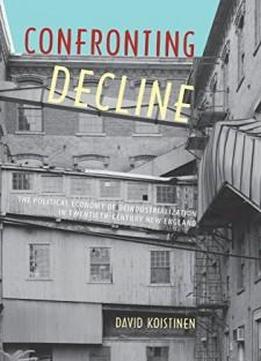
Confronting Decline: The Political Economy Of Deindustrialization In Twentieth-century New England (working In The Americas)
by David Koistinen /
2013 / English / PDF
2.2 MB Download
“Koistinen puts the ‘political’ back in political economy in
this fascinating account of New England’s twentieth-century
industrial erosion. First-rate research and sound judgments
make this study essential reading.”—Philip Scranton, Rutgers
University–Camden
“Koistinen puts the ‘political’ back in political economy in
this fascinating account of New England’s twentieth-century
industrial erosion. First-rate research and sound judgments
make this study essential reading.”—Philip Scranton, Rutgers
University–Camden
“Well-organized and clearly written,
“Well-organized and clearly written,Confronting Decline
Confronting Decline
looks at one community to understand a process that has become
truly national.”—David Stebenne, Ohio State University
looks at one community to understand a process that has become
truly national.”—David Stebenne, Ohio State University
“Koistinen’s important book makes clear that many industrial
cities and regions began to decline as early as the
1920s.”—Alan Brinkley, Columbia University
“Koistinen’s important book makes clear that many industrial
cities and regions began to decline as early as the
1920s.”—Alan Brinkley, Columbia University
“Sheds new light on a complex system of enterprise that
sometimes blurs, and occasionally overrides, the distinctions
of private and public, as well as those of locality, state,
region, and nation. In so doing, it extends and deepens the
insights of previous scholars of the American political
economy.”—Robert M. Collins, University of Missouri
“Sheds new light on a complex system of enterprise that
sometimes blurs, and occasionally overrides, the distinctions
of private and public, as well as those of locality, state,
region, and nation. In so doing, it extends and deepens the
insights of previous scholars of the American political
economy.”—Robert M. Collins, University of Missouri
The rise of the United States to a position of global
leadership and power rested initially on the outcome of the
Industrial Revolution. Yet as early as the 1920s, important
American industries were in decline in the places where they
had originally flourished.
The rise of the United States to a position of global
leadership and power rested initially on the outcome of the
Industrial Revolution. Yet as early as the 1920s, important
American industries were in decline in the places where they
had originally flourished.
The decline of traditional
manufacturing—deindustrialization—has been one of the most
significant aspects of the restructuring of the American
economy. In this volume, David Koistinen examines the demise of
the textile industry in New England from the 1920s through the
1980s to better understand the impact of industrial decline.
Focusing on policy responses to deindustrialization at the
state, regional, and federal levels, he offers an in-depth look
at the process of industrial decline over time and shows how
this pattern repeats itself throughout the country and the
world.
The decline of traditional
manufacturing—deindustrialization—has been one of the most
significant aspects of the restructuring of the American
economy. In this volume, David Koistinen examines the demise of
the textile industry in New England from the 1920s through the
1980s to better understand the impact of industrial decline.
Focusing on policy responses to deindustrialization at the
state, regional, and federal levels, he offers an in-depth look
at the process of industrial decline over time and shows how
this pattern repeats itself throughout the country and the
world.