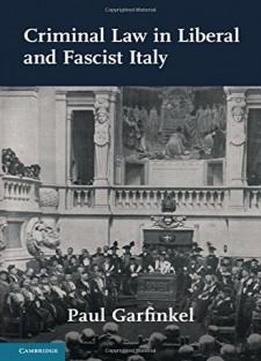
Criminal Law In Liberal And Fascist Italy (studies In Legal History)
by Paul Garfinkel /
2017 / English / PDF
11.8 MB Download
By extending the chronological parameters of existing scholarship,
and by focusing on legal experts' overriding and enduring concern
with 'dangerous' forms of common crime, this study offers a major
reinterpretation of criminal-law reform and legal culture in Italy
from the Liberal (1861-1922) to the Fascist era (1922-43).
Garfinkel argues that scholars have long overstated the influence
of positivist criminology on Italian legal culture and that the
kingdom's penal-reform movement was driven not by the radical
criminological theories of Cesare Lombroso, but instead by a
growing body of statistics and legal researches that related rising
rates of crime to the instability of the Italian state. Drawing on
a vast array of archival, legal and official sources, the author
explains the sustained and wide-ranging interest in penal-law
reform that defined this era in Italian legal history while
analyzing the philosophical underpinnings of that reform and its
relationship to contemporary penal-reform movements abroad.
By extending the chronological parameters of existing scholarship,
and by focusing on legal experts' overriding and enduring concern
with 'dangerous' forms of common crime, this study offers a major
reinterpretation of criminal-law reform and legal culture in Italy
from the Liberal (1861-1922) to the Fascist era (1922-43).
Garfinkel argues that scholars have long overstated the influence
of positivist criminology on Italian legal culture and that the
kingdom's penal-reform movement was driven not by the radical
criminological theories of Cesare Lombroso, but instead by a
growing body of statistics and legal researches that related rising
rates of crime to the instability of the Italian state. Drawing on
a vast array of archival, legal and official sources, the author
explains the sustained and wide-ranging interest in penal-law
reform that defined this era in Italian legal history while
analyzing the philosophical underpinnings of that reform and its
relationship to contemporary penal-reform movements abroad.