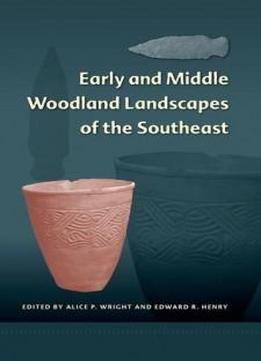
Early And Middle Woodland Landscapes Of The Southeast (florida Museum Of Natural History: Ripley P. Bullen Series)
by Alice P. Wright /
2013 / English / PDF
25.1 MB Download
“This is the first volume in a decade to address the Woodland
period in the Southeast. The research is fresh and reports new
information and interpretations gleaned from a variety of
sources—new excavations, geophysics, grey literature, older
collections—and covers a range of studies from single sites to
specific archaeological complexes to interactions among
complexes.”—Lynne P. Sullivan, coeditor of
“This is the first volume in a decade to address the Woodland
period in the Southeast. The research is fresh and reports new
information and interpretations gleaned from a variety of
sources—new excavations, geophysics, grey literature, older
collections—and covers a range of studies from single sites to
specific archaeological complexes to interactions among
complexes.”—Lynne P. Sullivan, coeditor ofMississippian
Mortuary Practices
Mississippian
Mortuary Practices
“This volume fills an important gap in Southeast archaeology,
the Early and Middle Woodland periods. It contains the best
that the current generation of archaeologists has to offer, set
in the context of the broader landscape of regional
archaeology.”—Dean R. Snow, author of
“This volume fills an important gap in Southeast archaeology,
the Early and Middle Woodland periods. It contains the best
that the current generation of archaeologists has to offer, set
in the context of the broader landscape of regional
archaeology.”—Dean R. Snow, author ofArchaeology of Native
North America
Archaeology of Native
North America
The Early and Middle Woodland periods (1000 BCE–500 CE) in
North America witnessed remarkable cross-cultural social
interactions as well as novel interactions between people and
the physical world. Using case studies from Georgia, Florida,
North Carolina, Mississippi, Kentucky, Alabama, and Tennessee,
this volume sheds new light on these dynamic and complex social
landscapes.
The Early and Middle Woodland periods (1000 BCE–500 CE) in
North America witnessed remarkable cross-cultural social
interactions as well as novel interactions between people and
the physical world. Using case studies from Georgia, Florida,
North Carolina, Mississippi, Kentucky, Alabama, and Tennessee,
this volume sheds new light on these dynamic and complex social
landscapes.
Fourteen in-depth case studies incorporate empirical data with
theoretical concepts such as ritual, aggregation, and
place-making, highlighting the variability and common themes in
the relationships between people, landscapes, and the built
environment that characterize this period of North American
native life in the Southeast.
Fourteen in-depth case studies incorporate empirical data with
theoretical concepts such as ritual, aggregation, and
place-making, highlighting the variability and common themes in
the relationships between people, landscapes, and the built
environment that characterize this period of North American
native life in the Southeast.