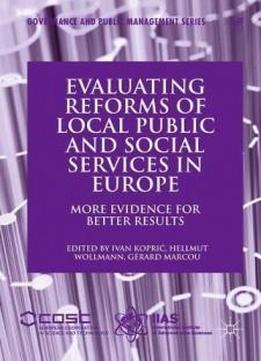
Evaluating Reforms Of Local Public And Social Services In Europe: More Evidence For Better Results (governance And Public Management)
by Hellmut Wollmann /
2017 / English / PDF
3 MB Download
This book explains the increasing demand for evaluation as a result
of the increasing frequency of reforms to local services,
influenced by the New Public Management doctrine, the severe
austerity policy in many European countries, and the wish to
increase quality and reduce costs of public services, especially at
the local (sub-national) level. Positioned at the interface of
local services and evaluation research, it will enable the
utilization of evaluation-generated knowledge in evidence-based
policy making by focusing on the lessons learned from evaluation of
local service delivery. It encompasses local public and social
services (including waste, water, public transport, healthcare,
education and eldercare) and examines the hypothesis that there is
a North-West–South-East divide in Europe in terms of the evaluation
of local service reforms. Particular attention is devoted to the
explanatory function of evaluation. Providing fresh insight into
the functioning of local government machinery in contemporary
Europe, this book will appeal in particular to practitioners and
students of local government, public economy, public administration
and policy.
This book explains the increasing demand for evaluation as a result
of the increasing frequency of reforms to local services,
influenced by the New Public Management doctrine, the severe
austerity policy in many European countries, and the wish to
increase quality and reduce costs of public services, especially at
the local (sub-national) level. Positioned at the interface of
local services and evaluation research, it will enable the
utilization of evaluation-generated knowledge in evidence-based
policy making by focusing on the lessons learned from evaluation of
local service delivery. It encompasses local public and social
services (including waste, water, public transport, healthcare,
education and eldercare) and examines the hypothesis that there is
a North-West–South-East divide in Europe in terms of the evaluation
of local service reforms. Particular attention is devoted to the
explanatory function of evaluation. Providing fresh insight into
the functioning of local government machinery in contemporary
Europe, this book will appeal in particular to practitioners and
students of local government, public economy, public administration
and policy.