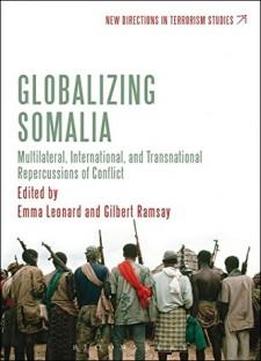
Globalizing Somalia: Multilateral, International And Transnational Repercussions Of Conflict (new Directions In Terrorism Studies)
by Gilbert Ramsay /
2013 / English / PDF
1.3 MB Download
This collection of essays demonstrates how chronic state failure
and the inability of the international community to provide a
solution to the conflict in Somalia has had transnational
repercussions.
This collection of essays demonstrates how chronic state failure
and the inability of the international community to provide a
solution to the conflict in Somalia has had transnational
repercussions.
Following the failed humanitarian mission in 1992-93, most
countries refrained from any direct involvement in Somalia, but
this changed in the 2000s with the growth of piracy and links to
international terrorist organizations. The deterritorialization
of the conflict quickly became apparent as it became
transnational in nature. In part because of it lacked a
government and was unable to work with the international
community, Somalia came to be seen as a "testing-ground" by many
international actors.
Following the failed humanitarian mission in 1992-93, most
countries refrained from any direct involvement in Somalia, but
this changed in the 2000s with the growth of piracy and links to
international terrorist organizations. The deterritorialization
of the conflict quickly became apparent as it became
transnational in nature. In part because of it lacked a
government and was unable to work with the international
community, Somalia came to be seen as a "testing-ground" by many
international actors.Globalizing Somalia
Globalizing Somalia demonstrates how
China, Japan, and the EU, among others, have all used the
conflict in Somalia to project power, test the bounds of the
national constitution, and test their own military capabilities.
demonstrates how
China, Japan, and the EU, among others, have all used the
conflict in Somalia to project power, test the bounds of the
national constitution, and test their own military capabilities.
Contributed by international scholars and experts, the work
examines the impact of globalization on the internal and external
dynamics of the conflict, arguing that it is no longer
geographically contained. By bringing together the many actors
and issues involved, the book fills a gap in the literature as
one of the most complete works on the conflict in Somalia to
date. It will be an essential text to any student interested in
Somalia and the horn of Africa, as well as in terrorism, and
conflict processes.
Contributed by international scholars and experts, the work
examines the impact of globalization on the internal and external
dynamics of the conflict, arguing that it is no longer
geographically contained. By bringing together the many actors
and issues involved, the book fills a gap in the literature as
one of the most complete works on the conflict in Somalia to
date. It will be an essential text to any student interested in
Somalia and the horn of Africa, as well as in terrorism, and
conflict processes.