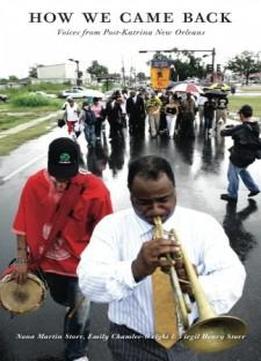
How We Came Back: Voices From Post-katrina New Orleans
by Nona Martin Storr /
2015 / English / EPUB
391 KB Download
On August 29, 2005, Hurricane Katrina made landfall in
southeastern Louisiana, displacing half a million people and
causing more than $100 billion in damage in the Greater New
Orleans region. The nation wondered how the people of New Orleans
could recover from a disaster of this magnitude, the costliest in
American history. Within a few years of Katrina, hundreds of
thousands had returned and were rebuilding their homes. How they
have come back is, to say the least, something of a puzzle.
On August 29, 2005, Hurricane Katrina made landfall in
southeastern Louisiana, displacing half a million people and
causing more than $100 billion in damage in the Greater New
Orleans region. The nation wondered how the people of New Orleans
could recover from a disaster of this magnitude, the costliest in
American history. Within a few years of Katrina, hundreds of
thousands had returned and were rebuilding their homes. How they
have come back is, to say the least, something of a puzzle.
A decade later, this book presents 17 oral histories of Hurricane
Katrina survivors from four diverse New Orleans communities. The
oral histories explore how these individuals, families, and
communities began to rebuild after the devastation. These
testimonies show that communities can be surprisingly resilient
in the wake of disaster, especially thanks to early and
disproportionately large individual efforts.
A decade later, this book presents 17 oral histories of Hurricane
Katrina survivors from four diverse New Orleans communities. The
oral histories explore how these individuals, families, and
communities began to rebuild after the devastation. These
testimonies show that communities can be surprisingly resilient
in the wake of disaster, especially thanks to early and
disproportionately large individual efforts.
Why have some communities rebounded quickly while others have
lagged behind? Even after accounting for obvious factors, such as
degree of damage, median income, and flood insurance, much of the
variance remains unexplained. What are the socially embedded
resources that communities have drawn on to develop effective
recovery strategies? Why, despite the commitment of significant
government resources, have many of the official forms of
assistance produced disappointing results?
Why have some communities rebounded quickly while others have
lagged behind? Even after accounting for obvious factors, such as
degree of damage, median income, and flood insurance, much of the
variance remains unexplained. What are the socially embedded
resources that communities have drawn on to develop effective
recovery strategies? Why, despite the commitment of significant
government resources, have many of the official forms of
assistance produced disappointing results?
This book explores the answers to these persistent questions,
which have dogged social scientists over the past 10 years.
Perhaps most importantly, it serves as fitting tribute to the
vision, resolve, and industriousness of those who came back.
This book explores the answers to these persistent questions,
which have dogged social scientists over the past 10 years.
Perhaps most importantly, it serves as fitting tribute to the
vision, resolve, and industriousness of those who came back.