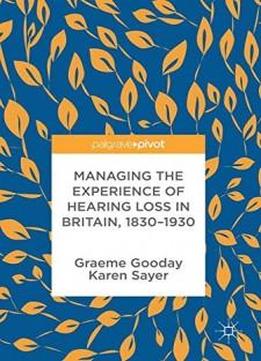
Managing The Experience Of Hearing Loss In Britain, 1830–1930
by Graeme Gooday /
2017 / English / PDF
1.7 MB Download
This book looks at how hearing loss among adults was experienced,
viewed and treated in Britain before the National Health
Service. We explore the changing status of ‘hard of hearing’ people
during the nineteenth century as categorized among diverse and
changing categories of ‘deafness’. Then we explore the advisory
literature for managing hearing loss, and techniques for
communicating with hearing aids, lip-reading and correspondence
networks. From surveying the commercial selling and daily use of
hearing aids, we see how adverse developments in eugenics prompted
otologists to focus primarily on the prevention of deafness. The
final chapter shows how hearing loss among First World War
combatants prompted hearing specialists to take a more supportive
approach, while it fell to the National Institute for the Deaf,
formed in 1924, to defend hard of hearing people against
unscrupulous hearing aid vendors. This book is suitable for both
academic audiences and the general reading public. All royalties
from sale of this book will be given to Action on Hearing Loss and
the National Deaf Children’s Society.
This book looks at how hearing loss among adults was experienced,
viewed and treated in Britain before the National Health
Service. We explore the changing status of ‘hard of hearing’ people
during the nineteenth century as categorized among diverse and
changing categories of ‘deafness’. Then we explore the advisory
literature for managing hearing loss, and techniques for
communicating with hearing aids, lip-reading and correspondence
networks. From surveying the commercial selling and daily use of
hearing aids, we see how adverse developments in eugenics prompted
otologists to focus primarily on the prevention of deafness. The
final chapter shows how hearing loss among First World War
combatants prompted hearing specialists to take a more supportive
approach, while it fell to the National Institute for the Deaf,
formed in 1924, to defend hard of hearing people against
unscrupulous hearing aid vendors. This book is suitable for both
academic audiences and the general reading public. All royalties
from sale of this book will be given to Action on Hearing Loss and
the National Deaf Children’s Society.