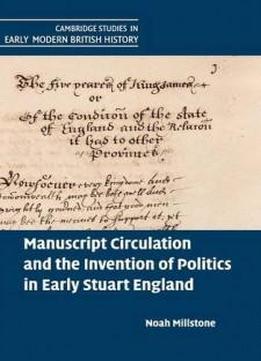
Manuscript Circulation And The Invention Of Politics In Early Stuart England (cambridge Studies In Early Modern British History)
by Noah Millstone /
2016 / English / PDF
4.7 MB Download
In the decades before the Civil War, English readers confronted an
extensive and influential pamphlet literature. This literature
addressed contemporary events in scathingly critical terms, was
produced in enormous quantities and was devoured by the curious.
Despite widespread contemporary interest and an enormous number of
surviving copies, this literature has remained almost entirely
unknown to scholars because it was circulated in handwriting rather
than printed with movable type. Drawing from book history, the
sociology of knowledge and the history of political thought, Noah
Millstone provides the first systematic account of the production,
circulation and reception of these manuscript pamphlets. By placing
them in the context of social change, state formation, and the
emergence of 'politic' expertise, Millstone uses the pamphlets to
resolve one of the central problems of early Stuart history: how
and why did the men and women of early seventeenth-century England
come to see their world as political?
In the decades before the Civil War, English readers confronted an
extensive and influential pamphlet literature. This literature
addressed contemporary events in scathingly critical terms, was
produced in enormous quantities and was devoured by the curious.
Despite widespread contemporary interest and an enormous number of
surviving copies, this literature has remained almost entirely
unknown to scholars because it was circulated in handwriting rather
than printed with movable type. Drawing from book history, the
sociology of knowledge and the history of political thought, Noah
Millstone provides the first systematic account of the production,
circulation and reception of these manuscript pamphlets. By placing
them in the context of social change, state formation, and the
emergence of 'politic' expertise, Millstone uses the pamphlets to
resolve one of the central problems of early Stuart history: how
and why did the men and women of early seventeenth-century England
come to see their world as political?