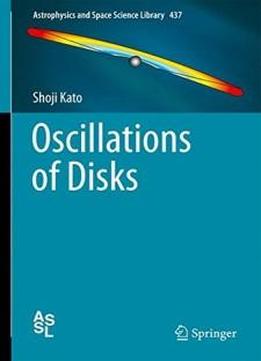
Oscillations Of Disks (astrophysics And Space Science Library)
by Shoji Kato /
2016 / English / PDF
4.3 MB Download
This book presents the current state of research on disk
oscillation theory, focusing on relativistic disks and tidally
deformed disks. Since the launch of the Rossi X-ray Timing Explorer
(RXTE) in 1996, many high-frequency quasiperiodic oscillations
(HFQPOs) have been observed in X-ray binaries. Subsequently,
similar quasi-periodic oscillations have been found in such
relativistic objects as microquasars, ultra-luminous X-ray sources,
and galactic nuclei. One of the most promising explanations of
their origin is based on oscillations in relativistic disks, and a
new field called discoseismology is currently developing. After
reviewing observational aspects, the book presents the basic
characteristics of disk oscillations, especially focusing on those
in relativistic disks. Relativistic disks are essentially different
from Newtonian disks in terms of several basic characteristics of
their disk oscillations, including the radial distributions of
epicyclic frequencies.
This book presents the current state of research on disk
oscillation theory, focusing on relativistic disks and tidally
deformed disks. Since the launch of the Rossi X-ray Timing Explorer
(RXTE) in 1996, many high-frequency quasiperiodic oscillations
(HFQPOs) have been observed in X-ray binaries. Subsequently,
similar quasi-periodic oscillations have been found in such
relativistic objects as microquasars, ultra-luminous X-ray sources,
and galactic nuclei. One of the most promising explanations of
their origin is based on oscillations in relativistic disks, and a
new field called discoseismology is currently developing. After
reviewing observational aspects, the book presents the basic
characteristics of disk oscillations, especially focusing on those
in relativistic disks. Relativistic disks are essentially different
from Newtonian disks in terms of several basic characteristics of
their disk oscillations, including the radial distributions of
epicyclic frequencies.
In order to understand the basic processes of disk oscillations,
studies on binary systems are of importance, as they offer
valuable information on wave–wave coupling processes in disk
oscillations. Accordingly, some characteristics of oscillations
in deformed disks are also presented in this book.
In order to understand the basic processes of disk oscillations,
studies on binary systems are of importance, as they offer
valuable information on wave–wave coupling processes in disk
oscillations. Accordingly, some characteristics of oscillations
in deformed disks are also presented in this book.
The book consists of two parts. Points covered in Part I include,
for instance, the basic characteristics of disk oscillations,
classification of oscillation modes, and trapping of
oscillations. In Part II, the focus is mainly on excitation
processes of oscillations, while applications to observations are
also discussed.
The book consists of two parts. Points covered in Part I include,
for instance, the basic characteristics of disk oscillations,
classification of oscillation modes, and trapping of
oscillations. In Part II, the focus is mainly on excitation
processes of oscillations, while applications to observations are
also discussed.