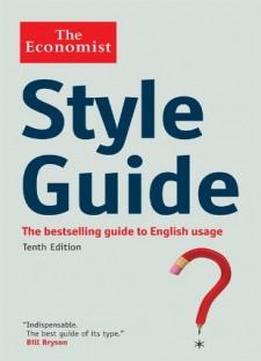
The Economist Style Guide
by Economist /
2012 / English / EPUB
19.7 MB Download
This expanded tenth edition of the bestselling guide to style is
based on the Economist's own updated house style manual, and is an
invaluable companion for everyone who wants to communicate with the
clarity, style and precision for which the Economist is renowned.
As the introduction says, 'clarity of writing usually follows
clarity of thought.' The Economist Style Guide gives general advice
on writing, points out common errors and cliches, offers guidance
on consistent use of punctuation, abbreviations and capital
letters, and contains an exhaustive range of reference material -
covering everything from accountancy ratios and stock market
indices to laws of nature and science. Some of the numerous useful
rules and common mistakes pointed out in the guide include: *Which
informs, that defines. This is the house that Jack built. But: This
house, which Jack built, is now falling down. *Discreet means
circumspect or prudent; discrete means separate or distinct.
Remember that "Questions are never indiscreet. Answers sometimes
are" (Oscar Wilde). *Flaunt means display, flout means disdain. If
you flout this distinction you will flaunt your ignorance *Forgo
means do without; forego means go before. *Fortuitous means
accidental, not fortunate or well-timed. *Times Take care.Three
times more than X is four times as much as X. *Full stops Use
plenty. They keep sentences short. This helps the reader.
This expanded tenth edition of the bestselling guide to style is
based on the Economist's own updated house style manual, and is an
invaluable companion for everyone who wants to communicate with the
clarity, style and precision for which the Economist is renowned.
As the introduction says, 'clarity of writing usually follows
clarity of thought.' The Economist Style Guide gives general advice
on writing, points out common errors and cliches, offers guidance
on consistent use of punctuation, abbreviations and capital
letters, and contains an exhaustive range of reference material -
covering everything from accountancy ratios and stock market
indices to laws of nature and science. Some of the numerous useful
rules and common mistakes pointed out in the guide include: *Which
informs, that defines. This is the house that Jack built. But: This
house, which Jack built, is now falling down. *Discreet means
circumspect or prudent; discrete means separate or distinct.
Remember that "Questions are never indiscreet. Answers sometimes
are" (Oscar Wilde). *Flaunt means display, flout means disdain. If
you flout this distinction you will flaunt your ignorance *Forgo
means do without; forego means go before. *Fortuitous means
accidental, not fortunate or well-timed. *Times Take care.Three
times more than X is four times as much as X. *Full stops Use
plenty. They keep sentences short. This helps the reader.