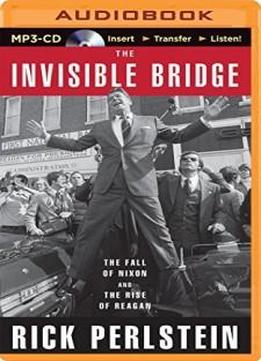
The Invisible Bridge: The Fall Of Nixon And The Rise Of Reagan
by Rick Perlstein /
2014 / English / PDF
1 GB Download
From the bestselling author of
From the bestselling author ofNixonland
Nixonland: a dazzling
portrait of America on the verge of a nervous breakdown in the
tumultuous political and economic times of the 1970s.
: a dazzling
portrait of America on the verge of a nervous breakdown in the
tumultuous political and economic times of the 1970s.
In January of 1973 Richard Nixon announced the end of the Vietnam
War and prepared for a triumphant second term—until televised
Watergate hearings revealed his White House as little better than
a mafia den. The next president declared upon Nixon’s resignation
“our long national nightmare is over”—but then congressional
investigators exposed the CIA for assassinating foreign leaders.
The collapse of the South Vietnamese government rendered moot the
sacrifice of some 58,000 American lives. The economy was in
tatters. And as Americans began thinking about their nation in a
new way—as one more nation among nations, no more providential
than any other—the pundits declared that from now on successful
politicians would be the ones who honored this chastened new
national mood.
In January of 1973 Richard Nixon announced the end of the Vietnam
War and prepared for a triumphant second term—until televised
Watergate hearings revealed his White House as little better than
a mafia den. The next president declared upon Nixon’s resignation
“our long national nightmare is over”—but then congressional
investigators exposed the CIA for assassinating foreign leaders.
The collapse of the South Vietnamese government rendered moot the
sacrifice of some 58,000 American lives. The economy was in
tatters. And as Americans began thinking about their nation in a
new way—as one more nation among nations, no more providential
than any other—the pundits declared that from now on successful
politicians would be the ones who honored this chastened new
national mood.
Ronald Reagan never got the message. Which was why, when he
announced his intention to challenge President Ford for the 1976
Republican nomination, those same pundits dismissed him—until,
amazingly, it started to look like he might just win. He was
inventing the new conservative political culture we know now, in
which a vision of patriotism rooted in a sense of American limits
was derailed in America’s Bicentennial year by the rise of the
smiling politician from Hollywood. Against a backdrop of
melodramas from the Arab oil embargo to Patty Hearst to the
near-bankruptcy of America’s greatest city,
Ronald Reagan never got the message. Which was why, when he
announced his intention to challenge President Ford for the 1976
Republican nomination, those same pundits dismissed him—until,
amazingly, it started to look like he might just win. He was
inventing the new conservative political culture we know now, in
which a vision of patriotism rooted in a sense of American limits
was derailed in America’s Bicentennial year by the rise of the
smiling politician from Hollywood. Against a backdrop of
melodramas from the Arab oil embargo to Patty Hearst to the
near-bankruptcy of America’s greatest city,The Invisible
Bridge
The Invisible
Bridge asks the question: what does it mean to believe in
America? To wave a flag—or to reject the glibness of the flag
wavers?
asks the question: what does it mean to believe in
America? To wave a flag—or to reject the glibness of the flag
wavers?