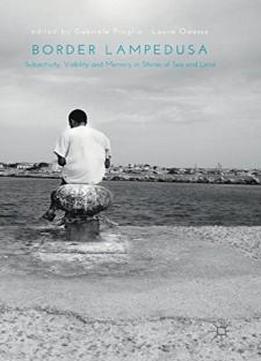
Border Lampedusa: Subjectivity, Visibility And Memory In Stories Of Sea And Land
by Gabriele Proglio /
2017 / English / PDF
4.3 MB Download
This book analyses the European border at Lampedusa as a metaphor
for visible and invisible powers that impinge on relations
between Europe and Africa/Asia. Taking an interdisciplinary
approach (political, social, cultural, economic and artistic), it
explores the island as a place where social relations based
around race, gender, sex, age and class are being reproduced
and/or subverted. The authors argue that Lampedusa should be
understood as a synecdoche for European borders and boundaries.
Widening the classical definition of the term ‘border’, the
authors examine the different meanings assigned to the term by
migrants, the local population, seafarers and associative actors
based on their subjective and embodied experiences. They reveal
how migration policies, international relations with African,
Middle Eastern and Asian countries, and the perpetuation of new
forms of colonization and imperialism entail heavy consequences
for the European Union. This work will appeal to a wide
readership, from scholars of migration, anthropology and
sociology, to students of political science, Italian, African and
cultural studies.
This book analyses the European border at Lampedusa as a metaphor
for visible and invisible powers that impinge on relations
between Europe and Africa/Asia. Taking an interdisciplinary
approach (political, social, cultural, economic and artistic), it
explores the island as a place where social relations based
around race, gender, sex, age and class are being reproduced
and/or subverted. The authors argue that Lampedusa should be
understood as a synecdoche for European borders and boundaries.
Widening the classical definition of the term ‘border’, the
authors examine the different meanings assigned to the term by
migrants, the local population, seafarers and associative actors
based on their subjective and embodied experiences. They reveal
how migration policies, international relations with African,
Middle Eastern and Asian countries, and the perpetuation of new
forms of colonization and imperialism entail heavy consequences
for the European Union. This work will appeal to a wide
readership, from scholars of migration, anthropology and
sociology, to students of political science, Italian, African and
cultural studies.