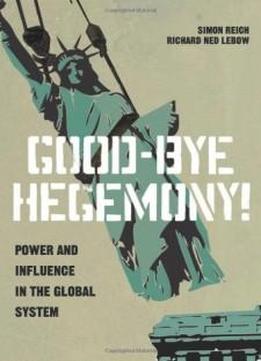
Good-bye Hegemony!: Power And Influence In The Global System
by Richard Ned Lebow /
2014 / English / PDF
2.1 MB Download
Many policymakers, journalists, and scholars insist that U.S.
hegemony is essential for warding off global chaos.
Many policymakers, journalists, and scholars insist that U.S.
hegemony is essential for warding off global chaos.Good-Bye
Hegemony!
Good-Bye
Hegemony! argues that hegemony is a fiction propagated to
support a large defense establishment, justify American claims to
world leadership, and buttress the self-esteem of voters. It is
also contrary to American interests and the global order. Simon
Reich and Richard Ned Lebow argue that hegemony should instead
find expression in agenda setting, economic custodianship, and
the sponsorship of global initiatives. Today, these functions are
diffused through the system, with European countries, China, and
lesser powers making important contributions. In contrast, the
United States has often been a source of political and economic
instability.
argues that hegemony is a fiction propagated to
support a large defense establishment, justify American claims to
world leadership, and buttress the self-esteem of voters. It is
also contrary to American interests and the global order. Simon
Reich and Richard Ned Lebow argue that hegemony should instead
find expression in agenda setting, economic custodianship, and
the sponsorship of global initiatives. Today, these functions are
diffused through the system, with European countries, China, and
lesser powers making important contributions. In contrast, the
United States has often been a source of political and economic
instability.
Rejecting the focus on power common to American realists and
liberals, the authors offer a novel analysis of influence. In the
process, they differentiate influence from power and power from
material resources. Their analysis shows why the United States,
the greatest power the world has ever seen, is increasingly
incapable of translating its power into influence. Reich and
Lebow use their analysis to formulate a more realistic place for
America in world affairs.
Rejecting the focus on power common to American realists and
liberals, the authors offer a novel analysis of influence. In the
process, they differentiate influence from power and power from
material resources. Their analysis shows why the United States,
the greatest power the world has ever seen, is increasingly
incapable of translating its power into influence. Reich and
Lebow use their analysis to formulate a more realistic place for
America in world affairs.