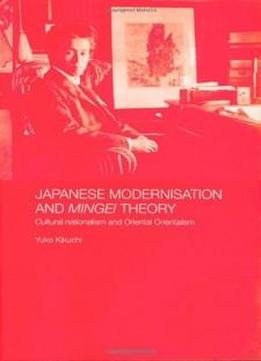
Japanese Modernisation And Mingei Theory: Cultural Nationalism And Oriental Orientalism
by Yuko Kikuchi /
2004 / English / PDF
20.9 MB Download
Conceptualised in 1920s Japan by Yanagi Sôetsu, the Mingei movement
has spread world wide since the 1950s, creating phenomena as
diverse as Mingei museums, Mingei connoisseurs and collectors,
Mingei shops and Mingei restaurants. The theory, at its core and
its adaptation by Bernard Leach, has long been an influential
'Oriental' aesthetic for studio craft artists in the West. But why
did Mingei become so particularly influential to a western
audience? And could the 'Orientalness' perceived in Mingei theory
be nothing more than a myth? This richly illustrated work offers
controversial new evidence through its cross-cultural examination
of a wide range of materials in Japanese, English, Korean and
Chinese, bringing about startling new conclusions concerning
Japanese modernization and cultural authenticity. This new
interpretation of the Mingei movement will appeal to scholars of
Japanese art history as well as those with interests in cultural
identity in non-Western cultures.
Conceptualised in 1920s Japan by Yanagi Sôetsu, the Mingei movement
has spread world wide since the 1950s, creating phenomena as
diverse as Mingei museums, Mingei connoisseurs and collectors,
Mingei shops and Mingei restaurants. The theory, at its core and
its adaptation by Bernard Leach, has long been an influential
'Oriental' aesthetic for studio craft artists in the West. But why
did Mingei become so particularly influential to a western
audience? And could the 'Orientalness' perceived in Mingei theory
be nothing more than a myth? This richly illustrated work offers
controversial new evidence through its cross-cultural examination
of a wide range of materials in Japanese, English, Korean and
Chinese, bringing about startling new conclusions concerning
Japanese modernization and cultural authenticity. This new
interpretation of the Mingei movement will appeal to scholars of
Japanese art history as well as those with interests in cultural
identity in non-Western cultures.