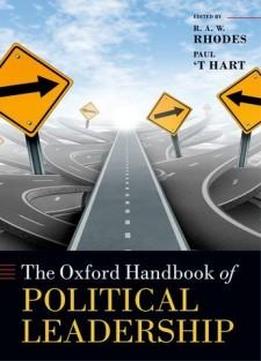
The Oxford Handbook Of Political Leadership (oxford Handbooks)
by Paul 'T Hart /
2014 / English / PDF
8.5 MB Download
Political leadership has made a comeback. It was studied
intensively not only by political scientists but also by political
sociologists and psychologists, Sovietologists, political
anthropologists, and by scholars in comparative and development
studies from the 1940s to the 1970s. Thereafter, the field lost its
way with the rise of structuralism, neo-institutionalism, and
rational choice approaches to the study of politics, government,
and governance. Recently, however, students of politics have
returned to studying the role of individual leaders and the
exercise of leadership to explain political outcomes. The list of
topics is nigh endless: elections, conflict management, public
policy, government popularity, development, governance networks,
and regional integration. In the media age, leaders are presented
and stage-managed--spun--as the solution to almost every social
problem. Through the mass media and the Internet, citizens and
professional observers follow the rise, impact, and fall of senior
political officeholders at closer quarters than ever before.
Political leadership has made a comeback. It was studied
intensively not only by political scientists but also by political
sociologists and psychologists, Sovietologists, political
anthropologists, and by scholars in comparative and development
studies from the 1940s to the 1970s. Thereafter, the field lost its
way with the rise of structuralism, neo-institutionalism, and
rational choice approaches to the study of politics, government,
and governance. Recently, however, students of politics have
returned to studying the role of individual leaders and the
exercise of leadership to explain political outcomes. The list of
topics is nigh endless: elections, conflict management, public
policy, government popularity, development, governance networks,
and regional integration. In the media age, leaders are presented
and stage-managed--spun--as the solution to almost every social
problem. Through the mass media and the Internet, citizens and
professional observers follow the rise, impact, and fall of senior
political officeholders at closer quarters than ever before.
This
ThisHandbook
Handbook encapsulates the resurgence by asking, where
are we today? It orders the multidisciplinary field by identifying
the distinct and distinctive contributions of the disciplines. It
meets the urgent need to take stock. It brings together scholars
from around the world, encouraging a comparative perspective, to
provide a comprehensive coverage of all the major disciplines,
methods, and regions. It showcases both the normative and empirical
traditions in political leadership studies, and juxtaposes
behavioural, institutional, and interpretive approaches. It covers
formal, office-based as well as informal, emergent political
leadership, and in both democratic and undemocratic polities.
encapsulates the resurgence by asking, where
are we today? It orders the multidisciplinary field by identifying
the distinct and distinctive contributions of the disciplines. It
meets the urgent need to take stock. It brings together scholars
from around the world, encouraging a comparative perspective, to
provide a comprehensive coverage of all the major disciplines,
methods, and regions. It showcases both the normative and empirical
traditions in political leadership studies, and juxtaposes
behavioural, institutional, and interpretive approaches. It covers
formal, office-based as well as informal, emergent political
leadership, and in both democratic and undemocratic polities.